One of my photographs was selected for the 2018 Minnesota State Fair Fine Arts Exhibition! After several years of solid rejections, I got one in. This is a 14″x18″ print on Ilford Classic 16×20 silver gelatin fiber paper enlarged from an 8×10 film negative in a traditional darkroom. Traditional portraiture with a large format film camera is apparently still a thing.
8×10 black and white film portrait enlarged in a darkroom on silver gelatin fiber paper.
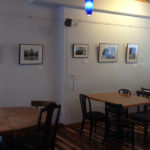
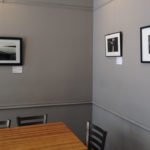
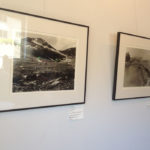
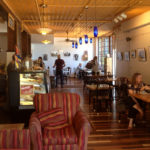
I have the good fortune to display 18 photographs at Amore Coffee in St. Paul for the summer. There are 5 new images and I’m happy to have them out in the world. This online gallery shows what is on display at Amore with the exception of four photographs. There are prints from formats ranging from 35mm to 8×10 large format black and white film, both contact prints and enlargements.
There are also Van Dyke Brown historic process prints and a couple of pinhole images as well. Finally, I threw in a few prints from digital files just for the fun of it. As always, something for everyone 🙂
It’s a great shop and the fresh-roasted coffee is superb, but that goes without saying! Stop by if you are in the area.
It’s 2017 and I’m making large format film portraits with a vintage 8×10 camera that is 100 years old. This camera is the Folmer & Schwing 8×10 Home Portrait Camera No. 1 with a 14” Wollensak Velostigmat Series II lens.
Why pursue photography with this combination? Photographs such as this one are made with a “view camera”, a camera where the photographer composes the image upside down and backwards on a ground glass on the back of the camera. View cameras use film that is typically 4″x5″ or larger, thus called large format. Often, images made with these cameras on large format film have a look that cannot be achieved in any other medium. The tonality has a smooth gradation between tones that feels open compared to smaller film formats. Also, vintage lenses designed for 4×5, 5×7, 8×10 or larger have a timeless character that is hard to replicate with modern photographic equipment.
Part of my artistic vision is to create photographs that are not easily identified with any particular period. Sometimes clothing or hairstyle gives it away, but other times it’s hard to tell whether a photograph is contemporary or made anytime back to 1928.
This portrait of a woman was made on Arista EDU Ultra 100 black and white film and drum processed for 9 minutes in Freestyle’s L110 developer at dilution H 1+62.
Portrait on large format film made with a vintage camera over 100 years old.
On occasion, I make Van Dyke Brown historic process prints using a technique that dates back to the mid 1800’s. What is an alt process, or historic process print? The short answer is a print made by putting a negative directly in contact with art paper that has been sensitized to record an image. A “standard” silver gelatin black and white print is made with photographic paper available from a commercial manufacturer. To make an alt process print, the photographer brushes the light sensitive chemicals onto the paper that has been selected for the print. After the paper is dry, the negative is pressed against the paper using a contact printing frame. Then, the paper and negative are exposed to UV light, either using the sun or a light box outfitted with bulbs that will expose print-out papers.
There are many different alternative processes and excellent books on the subject. My expertise is the Van Dyke Brown and I use 4×5 or 8×10 film or digital negatives. This portrait was made using 8×10 black and white film. You can see the brush strokes where the sensitizer was brushed onto the paper and the full border of the negative. Some people display their prints with the full border visible. Others cover the film border with a mat, showing only the image area. Although I like the brush strokes, I’d like to find some old-fashioned, cabinet card style oval mats to augment the turn-of-the-last-century style.
A portrait made using film and the Van Dyke Brown printing technique.
I was excited to participate in the 2015 F295 Salon exhibit at the University Art Gallery, Frick Fine Arts Building, University of Pittsburgh. My print just made the trip back safely and it’s now on the dining room wall. This is a one-of-a-kind print, an 8×10 contact print from a digital negative using the analog historic photographic process called Van Dyke Brown. Thanks again, Tom Persinger and F295!
Kauai Mist, 2002
Digital capture with Olympus C2000z 2.1mp
Printed 8×10 in 2015
Van Dyke Brown from digital negative